

R&D didn’t get a mention in the Budget speech. But tucked away in the Budget documents was one of the most welcome changes we’ve seen in a while: the claim notification form is going. From 1 April 2027, companies making R&D claims will no longer have to notify HMRC in advance.
What’s changing?
For accounting periods starting on or after 1 April 2023, first-time claimants, and companies that hadn’t claimed in the last three years, have had to submit a claim notification form. It had to reach HMRC within six months of the end of the accounting period. Miss it, and the claim is lost, however good the R&D.
HMRC’s policy paper, published on 28th October, confirms that this is changing!
“Companies making R&D claims on or after 1st April 2027 will no longer be required to submit a CNF.”
It applies to claims under both the merged RDEC scheme and ERIS. Clause 19 of the Finance Bill does this by repealing the notification rules in CTA 2009. The key line is short: the changes “have effect in relation to R&D claims made on or after 1 April 2027”. The Bill still has to complete its passage through Parliament.
Why it matters
In our look at HMRC’s 2026 statistics, we pointed out the ineffectiveness of the claim notification form. The businesses most likely to miss it are exactly the ones the scheme should be encouraging. These are first-time claimants, small companies without an adviser, and businesses that only realise late in the year that their work counts as R&D.
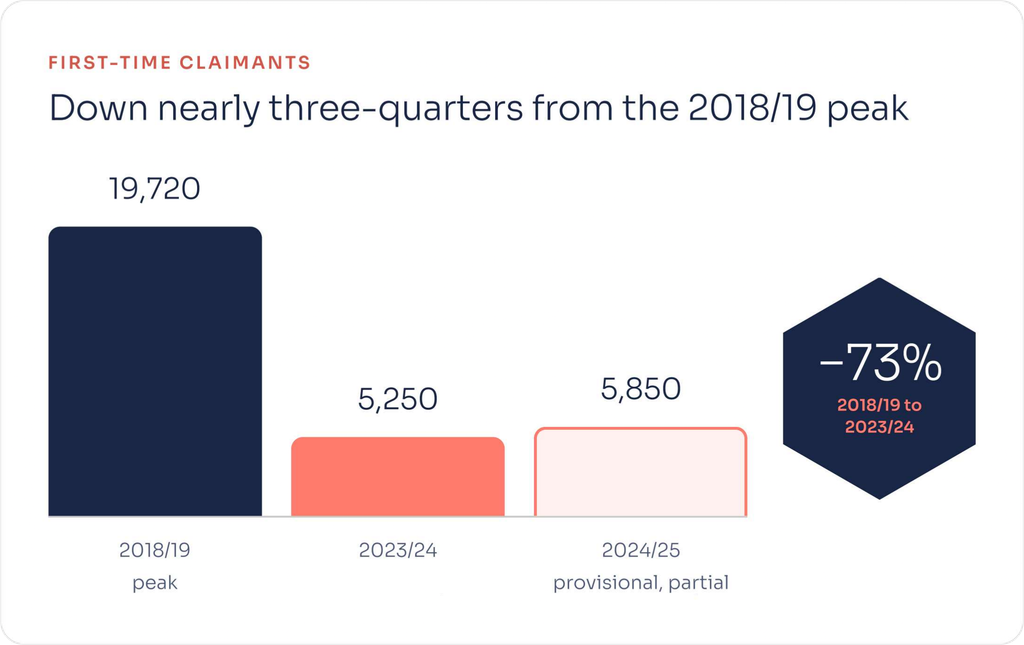
First-time claimants have fallen from 19,720 in 2018/19 to 5,250 in 2023/24. Removing a deadline that catches out new entrants won’t reverse that on its own, but it takes away one of the easiest ways to fall out of the scheme.
HMRC’s own reasoning is telling. It points to stakeholder feedback and “the reduced error and fraud risks now associated with the R&D regime”. That’s the clearest sign yet that the compliance pendulum is starting to swing back.
What else was announced?
- A simpler Additional Information Form (AIF), from autumn 2027. HMRC will cut back the information that the form asks for and tidy up the digital form. The details will follow before it comes in.
- More simplification to come. The government plans to work with advisers and businesses between November 2026 and April 2027. It will look at simplifying the ERIS R&D intensity test, the PAYE/NIC cap and the going concern rules, and at the wider claims process.
- Patent Box. The government will explore simplifying the calculation, including a possible de minimis for smaller companies.
Only the AIF change has a date so far. But together they all point the same way, less admin and less challenging for genuine claimants to claim.
What should you do now?
What counts is the date you make the claim, not your accounting period or when your notification would have been due. That gives two practical points.
If you’ll file before 1 April 2027, you still need to notify. For example, a first-time claimant with a 30 September 2026 year end has a notification deadline of 31 March 2027. If it wants to file its claim before April, it must notify on time. Until the Bill becomes law, we’d notify anyway. It takes a few minutes and removes any risk.
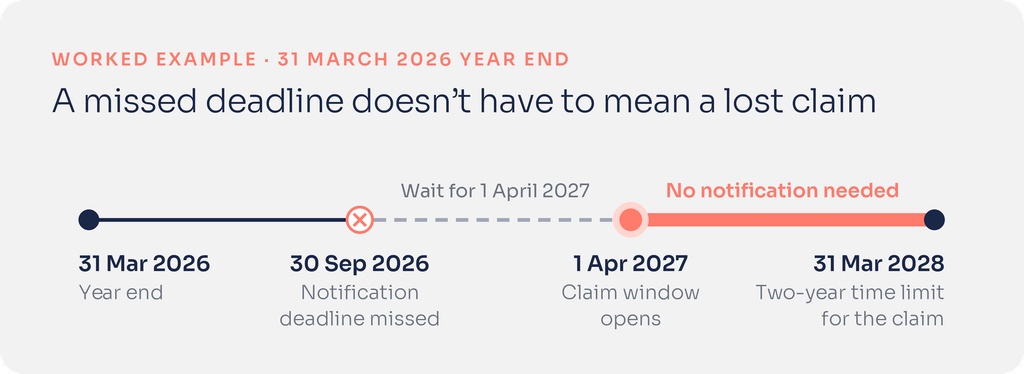
If you’ve already missed a deadline, don’t write the claim off. On the Bill’s wording, a claim made on or after 1 April 2027 needs no notification, even if the old deadline has passed. You still have the normal two years from the end of the accounting period to claim. So a company with a 31 March 2026 year end that missed its September 2026 deadline could still claim from April 2027, as long as it does so by 31 March 2028.
If you’re not sure whether you need to notify, or you’re thinking about claiming for the first time, get in touch. We’ll check where you stand.
About the author
Chris Alderson is Managing Director of Catalyst R&D. He trained with KPMG as a Tax Adviser back in 2010 and has worked in R&D tax for over a decade. He works on R&D tax relief claims and HMRC compliance checks for companies of all sizes. He works alongside the engineers and scientists on our team, so every claim is checked by people who know the tax and the technology.