

HMRC’s latest R&D tax credit statistics came out on 29 September. The headline sounds like good news: £8.2bn of relief claimed in 2024/25, up 5%. But look underneath and the real story is who is receiving it.
1.4% of claimants have half the relief!
Around 560 claims worth more than £2m each made up just 1.4% of all claims. Between them they took roughly £4.0bn, about 50% of all the relief claimed.
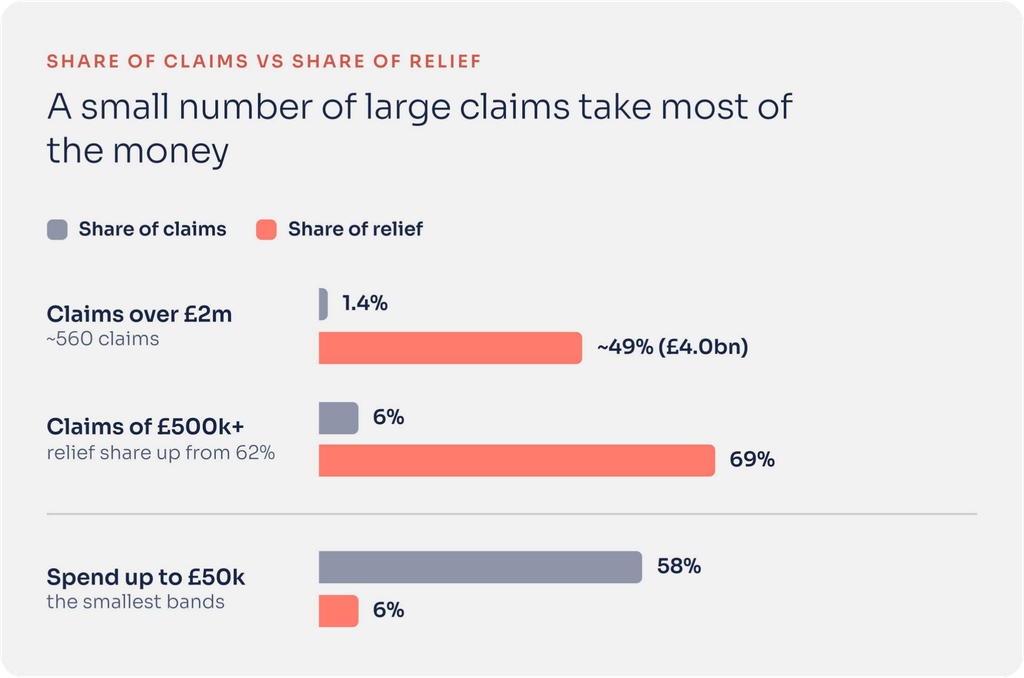
Widen the lens a little and it’s the same picture. Claims of £500k and above are 6% of claims made but take 69% of the relief, up from 62% a year earlier. At the other end, 58% of claims made sit in the bands up to £50k of R&D spend, and they share just 6% of the relief.
Some of this is the scheme doing what it was redesigned to do. The RDEC rate went from 13% to 20%, and the contracted-out rules in the merged scheme move the claim up the supply chain to the larger company. Both of these changes naturally favour bigger claimants.
But it’s worth asking the question out loud: is this what we want the scheme to be? R&D relief was meant to grow the base of innovative UK businesses, not just reward the ones already at scale. A scheme where half the money goes to 560 claims seems to be favouring fewer, much larger innovators.
Fewer but larger claims
The headline numbers for 2024/2025:
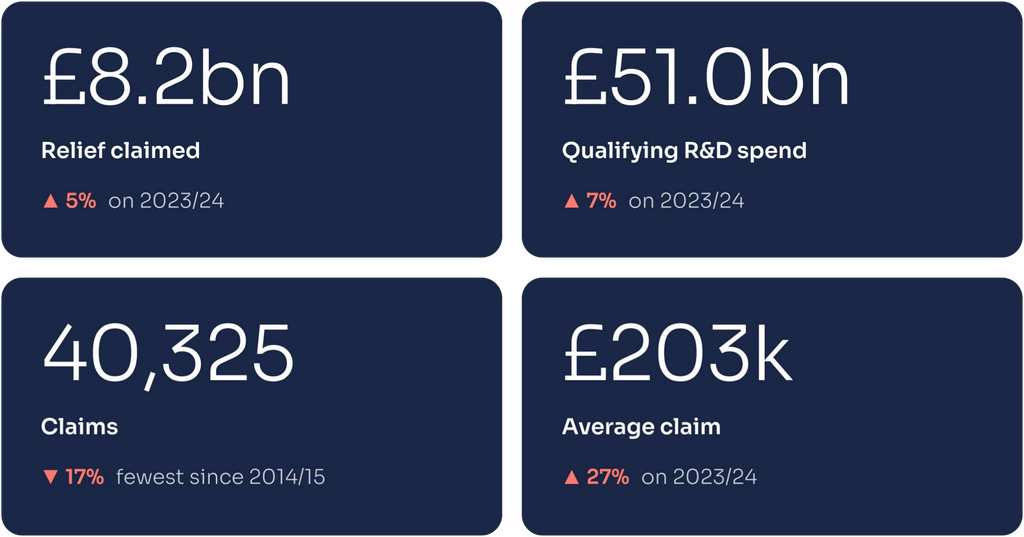
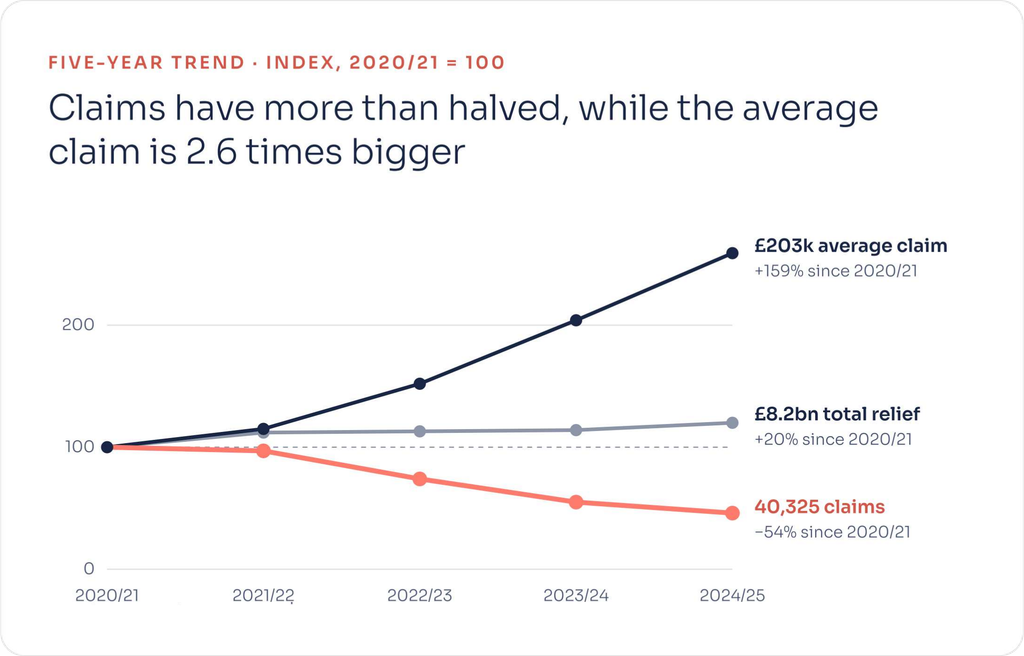
In five years, the number of claims has fallen by more than half, while the average claim has grown 2.6 times. Total relief has still gone up. The scheme isn’t shrinking, it’s becoming more concentrated.
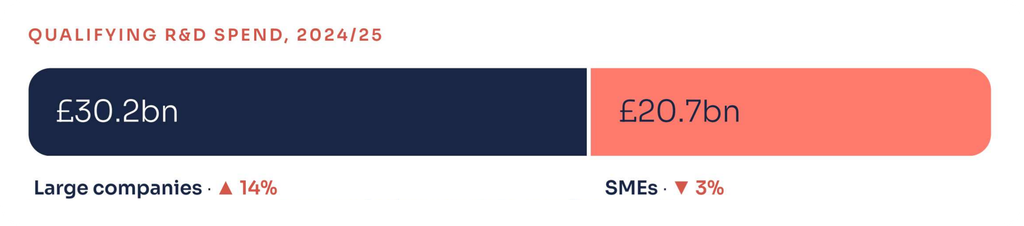
Part of that is a real shift towards large companies. Large-company R&D spend rose 14% to £30.2bn, while SME spend fell 3% to £20.7bn. Spend is a fairer test than relief here, because the rate changes distort the relief figures, but the gap still shows.
Where have all the claims gone?
Small claims are vanishing fastest. Claims in the bands up to £50k of spend fell by about 21% in a single year, from 29,645 to 23,375. Claims under £25k fell 23%.
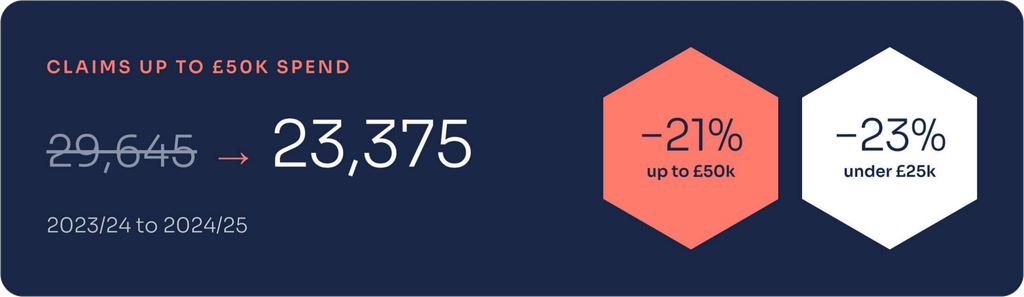
HMRC’s explanation is that a key driver is “believed to be” the Additional Information Form (AIF), mandatory since August 2023. We’re not convinced. If you were already writing up your projects properly, the AIF shouldn’t mean much more work. For a well-run claim it’s a continuation of existing practice, not a new hurdle.
There are around 47,000 fewer claims than at the 2020/21 peak. Blaming one form for that only works if you assume most of those claims had no real technical write-up behind them. That’s a big assumption to make!
We think something more fundamental has happened. Between the AIF, claim notification and the enquiry risk, the scheme has quietly put a question to every small business: is this still worth it? For a lot of smaller SMEs, the answer has become no.
Look at the maths. Under the merged scheme a profitable company gets roughly 15p back for every £1 of qualifying spend, so £50k of R&D is worth around £7,500. Before the merged scheme that same claim would have been worth £10,500.
Then add the part of the sum that rarely gets talked about: adviser fees.
After 2023, advisers responded to the extra work and risk in a few ways: introducing minimum fees, increasing fees, dropping enquiry support, handing claims to less experienced staff, or asking clients to do more of the work themselves. For a small claimant, every one of those makes a modest benefit look smaller, or riskier.
So they’re left with a choice. Pay a fee that eats a big slice of the benefit, take a cheaper route that leaves them exposed, or not claim at all. A large number appear to be choosing the last option. And sadly, that isn’t necessarily because they don’t have a legitimate R&D claim.
The missing new entrants
Another key number we find worrying is first-time claimants. They peaked at 19,720 in 2018/19 and had fallen to 5,250 by 2023/24. That’s the fifth fall in a row. First-time SME claimants alone dropped 53% in a single year, to 3,405.
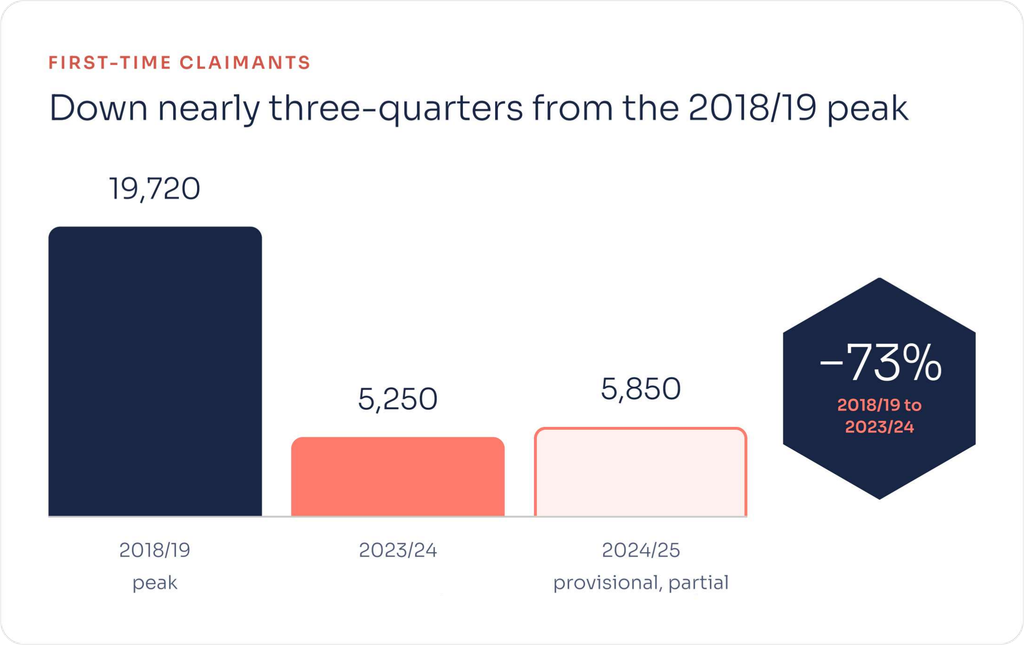
HMRC’s provisional figure for 2024/25 is 5,850, up 11%. Whilst that could be positive, it’s worth being aware that HMRC is calling the 24/25 data “partial” and doesn’t say what sits behind it. If it leans on claim notifications, a notification is only an intention to claim. It doesn’t guarantee a claim will follow. So you might expect the figure to come down once the full effect of notification shows through.
There’s a bigger blind spot. First-time (or lapsed) claimants have to notify HMRC within six months of their year end. Miss that deadline and the claim is lost. Those companies never reach HMRC’s tables at all. So the statistics will never show how many genuine claims are being lost this way.
Are start-ups just innovating less?
It’s tempting to blame a tough economy. The data only partly backs that up.
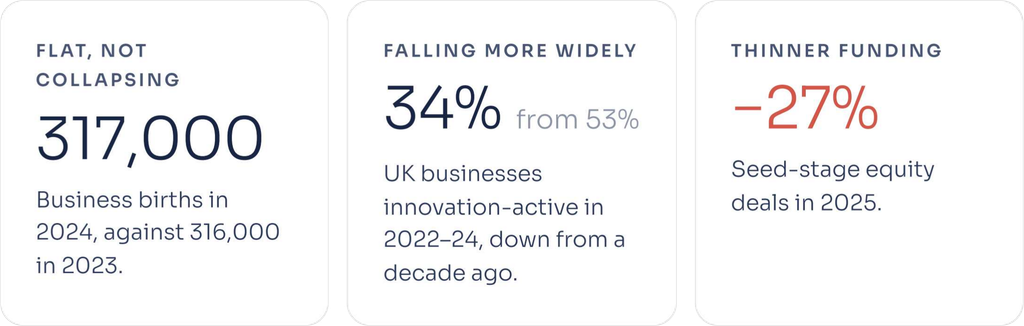
So the climate is tougher and fewer firms are innovating. But business births haven’t fallen anywhere near enough to explain a 73% drop in first-time claimants since 2018/19. It is clear that the scheme has become harder to find and harder to enter.
South West, North East and Wales are losing ground
Relief rose in most regions this year. The West Midlands was up 22% and the North West up 14%. But two regions went sharply the other way: the North East (down 11.5%) and the South West, where Catalyst is based (down 11.4%). They are the two biggest falls in the country.
Wales looks better on the surface, with relief up 4%. But its claim numbers fell almost 20%, the second-sharpest fall of any region, and its relief is still nearly a fifth below 2021/22.
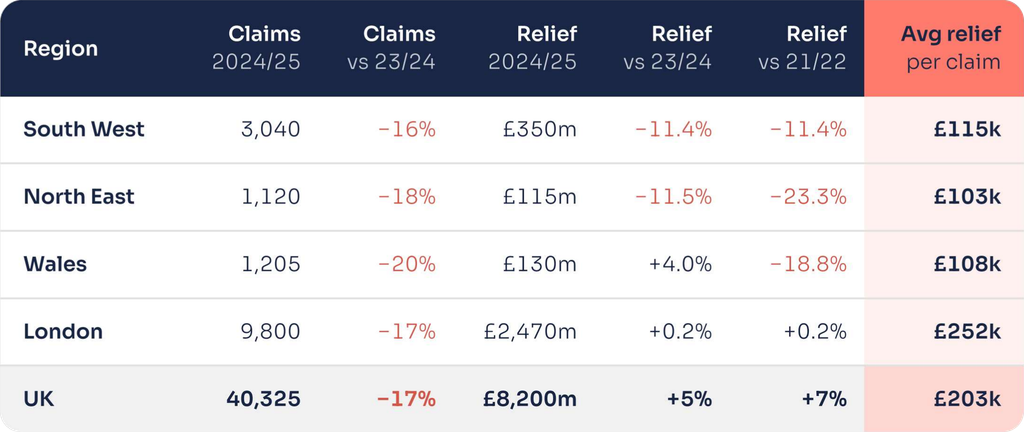
The last column tells the story. The average claim in all three regions is roughly half the UK figure. These are economies built on SMEs, manufacturers and supply-chain businesses. They are exactly the claimants the rate changes, the contracted-out rules and the de facto de minimis hit hardest.
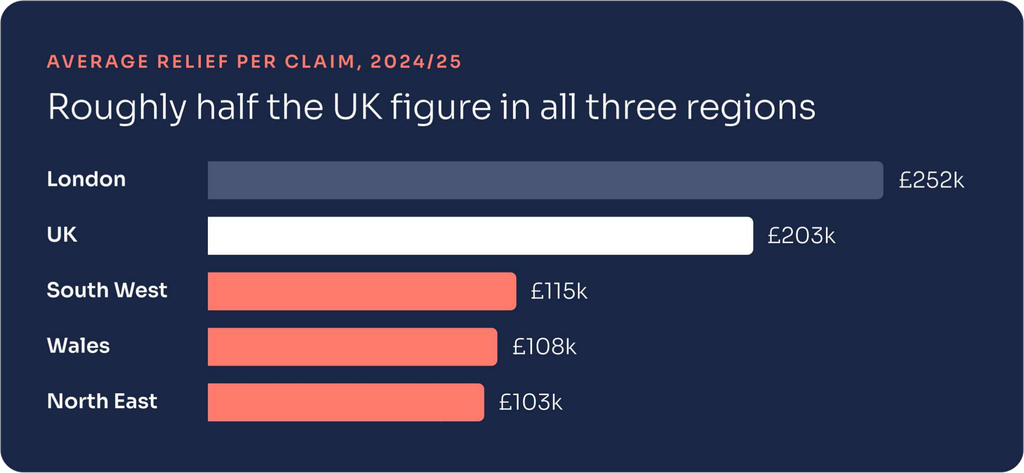
Together, the North East and Wales make up under 6% of UK claims and around 3% of UK relief. It’s one reason we’ve spent so much time talking to Welsh manufacturers this year. Plenty of qualifying R&D is going on in these regions. It just isn’t being claimed.
It begs the question is a relief which is leaving our SMEs, our first-time claimants and our wider regions behind, and instead focusing on a handful of large companies mainly based in the South East and London, really doing the job that it is supposed to be doing!
One quiet bright spot: ERIS
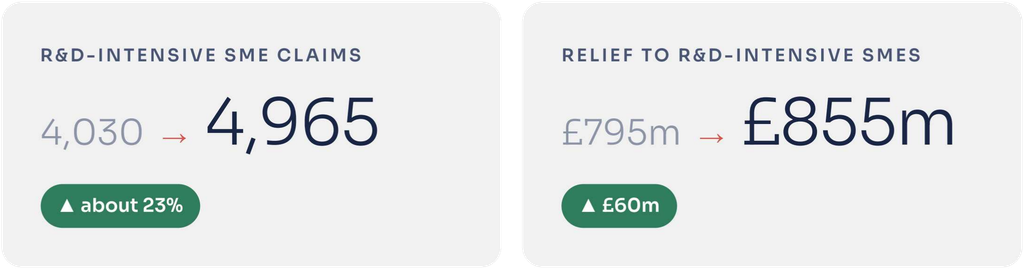
Among all the SME gloom, one group grew. Claims from R&D-intensive SMEs (the old intensive rate, now ERIS) rose from 4,030 to 4,965, about 23%. Their relief went from £795m to £855m. Hardly anyone has commented on it, but it suggests the most R&D-heavy small businesses are still finding their way to the relief.
What to watch next year
The 2024/25 figures are provisional, and it’s a transition year, with the old and new schemes running side by side. The next release, due in autumn 2027, will give the first full year of merged-scheme and ERIS data. It should also give a clearer view of what claim notification has done to new entrants.
The questions we’ll be asking:
- Does the number of first-time SME claimants stabilise, or keep falling?
- Does HMRC’s move away from volume compliance bring genuine smaller claimants back?
- Do the South West, North East and Wales start to close the gap?
- And is a scheme where 1.4% of claims take half the relief the one we actually want?
About the author
Chris Alderson is Managing Director of Catalyst R&D. He trained with KPMG as a Tax Adviser back in 2010 and has worked in R&D tax for over a decade. He works on R&D tax relief claims and HMRC compliance checks for companies of all sizes. He works alongside the engineers and scientists on our team, so every claim is checked by people who know the tax and the technology.